




Introduction
Questions that seem simple on the surface have long intrigued me, yet they reveal deep historical and conceptual dimensions: Why was the circle divided into 360 degrees? Why does the year consist of 12 months? And how did the week become fixed at seven days?
Such questions help us understand how ancient societies organized time, and how their choices eventually solidified into systems we still live within today.
In this preliminary study, I turn to a more focused yet deeper question: What do the names of the days of the week in Amazigh reveal about the Amazigh conception of time and its connection to daily work?
Origin of the Names of the Days
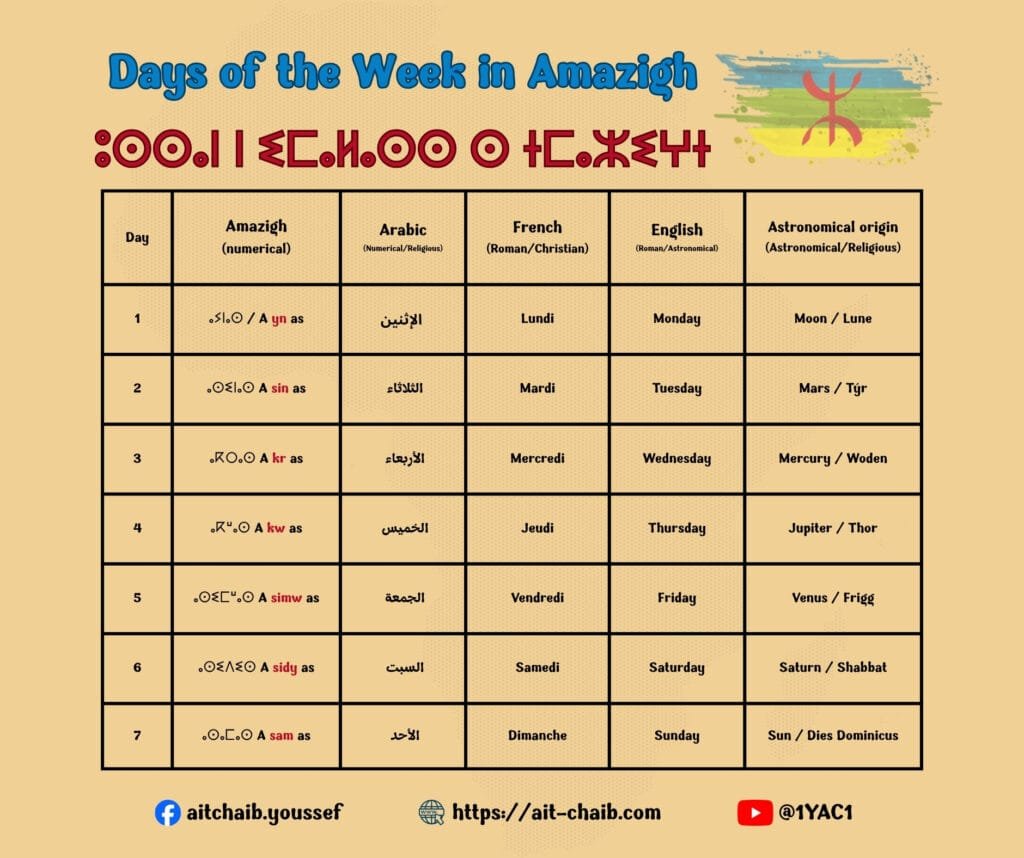
The attached image presents a comparative table of the Amazigh days of the week alongside their equivalents in Arabic and several European languages, with notes on astronomical and mythological origins.
The Amazigh names follow a clear numerical logic: each day is derived from a root indicating a number. The sequence begins with Aynas (from the root meaning “day one”: A-yin-as), followed by Asinas (A-sin-as, day two), Akrās (day three), then Akuas, Asimwas, Asidiyas, and finally Asamas.
This linguistic structure reflects a traditional counting system largely independent of planetary or ritual references. It conveys a conception of time as a functional sequence of stages corresponding to daily work.
Why Does the Week Begin on Monday?
The Amazigh week begins with Aynas, considered the starting point of agricultural and craft activities after a day of rest and market.
This arrangement reflects a practical logic: beginning the week with the resumption of work rather than with a sacred day. It corresponds to societies in which the meaning of days was shaped primarily by cycles of labor and markets rather than by religious rituals.
It is important to note that this functional interpretation remains subject to historical verification and may require ethnographic or epigraphic evidence to support it.
Comparison with Other Ancient Time Systems
Many ancient civilizations developed weekly systems tied to economic or religious functions. In Mediterranean and North African societies prior to Semitic and Greco-Roman influence, weekly cycles often began with a working day and ended with a day for rest or market—an arrangement reflecting agricultural communities whose rhythms were governed by seasons, sowing, and harvest rather than religious observances.
Conversely, Semitic calendars—such as the Hebrew and later the Arabic—centered the week around a sacred day: Shabbat for Jews, Dies dominica (Sunday) for Christians, or Friday for Muslims. This sacred day became the starting or ending point of the week, structuring temporal rhythm around a theological reference.
The Amazigh system, however, preserved its original practical logic: the week begins with Aynas, the first day of the count, and unfolds numerically without a central sacred day reorganizing the cycle.
This distinction highlights a uniquely Amazigh conception of time—one that places production and labor at the core of the weekly rhythm, in contrast to systems structured around ritual and liturgy.
Conclusion
The Amazigh system of naming the days of the week presents a temporal model distinct from the religious or astronomical systems adopted by many other civilizations. It is a system built on direct enumeration from one to seven, reflecting a practical view of time in which work—not ritual, planet, or myth—is the central reference.
Compared with other systems of the Mediterranean and Near Eastern regions, the Amazigh calendar stands out for its autonomy: it begins and ends with the cycle of labor, without reorienting itself around a sacred day as Semitic calendars later did.
This difference is not merely linguistic; it reveals a deeper conception of time as an extension of daily life, the rhythm of the land, and the organization of work within agricultural societies.
Thus, studying Amazigh day names provides a key to understanding the Amazigh relationship to time—a functional, pragmatic relationship rooted in cycles of production rather than religious motivations.
The language, in this sense, remains a witness to ancient modes of thought and carries within it the memory of social and cultural structures whose traces continue to shape the details of our everyday lives.