
- Introduction
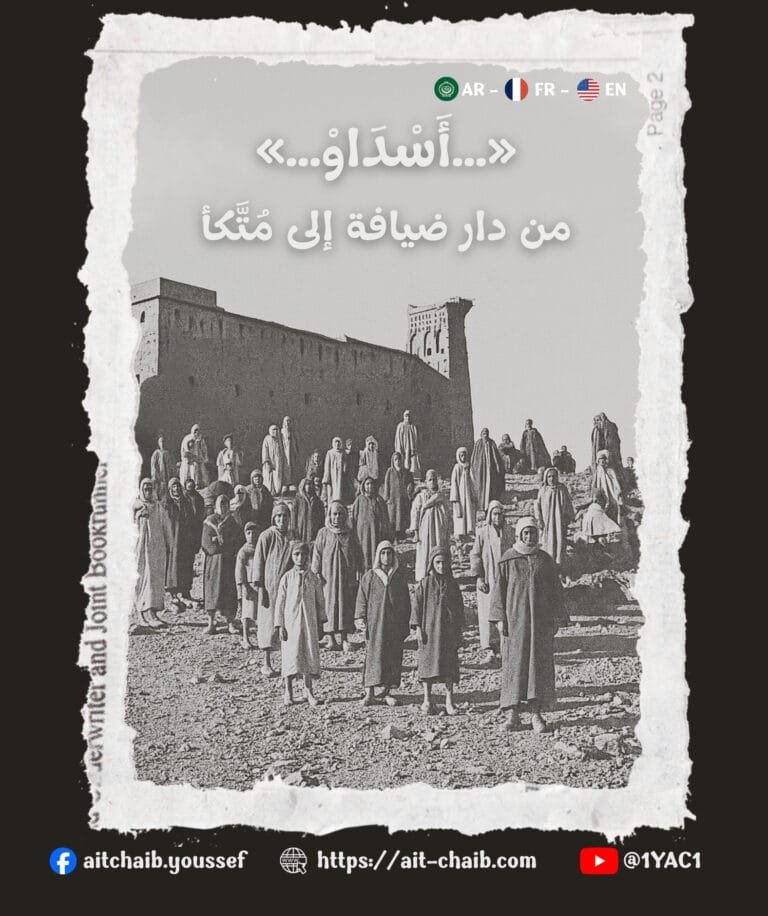
Before the modern city of Ouarzazate emerged, there was a single place where people from all surrounding douars and regions gathered: the Thursday market of Sidi Othmane. A weekly market bustling with activity, where caravans from Marrakech, the Drâa Valley, Dadès, and Taznakht intersected. It offered all kinds of goods—grains, dates, wool—alongside the jewelry, garments, and furnishings brought by merchants depending on the season. It was also where disputes were settled and deals concluded.
The market was more than a day of trade; it was the beating heart of Ouarzazate before administrative roads and modern kasbahs existed. It was recorded by Mohammed ben Nasser ad-Dir‘i in the seventeenth century, and centuries later described by Charles de Foucauld as the largest market in the region.
This article seeks to reconstruct the image of that old market: how it emerged, what role it played, and how it brought Ouarzazate together long before the city itself was born.
- The Market’s Location and Nature

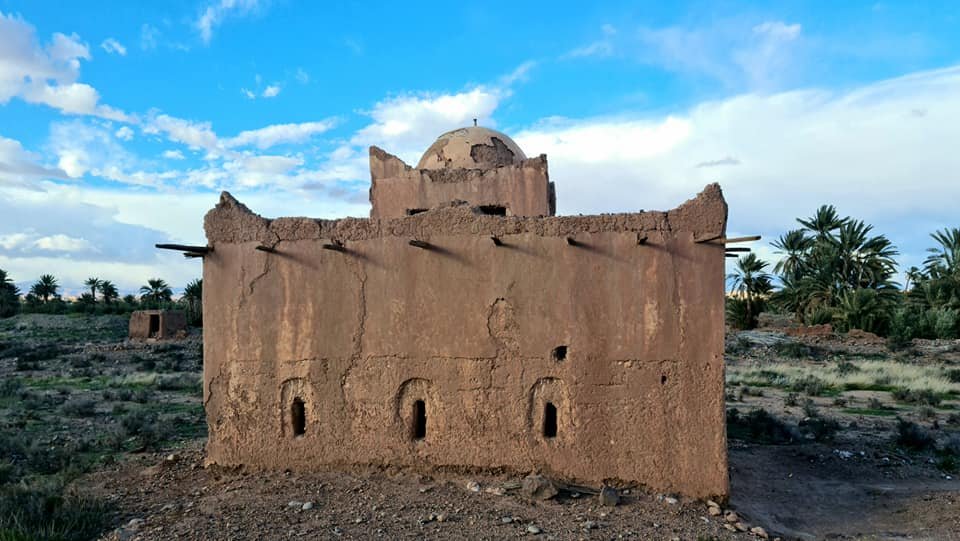
Khmiss Sidi Othmane developed in a site whose geographic and social features made it a natural focal point of the Ouarzazate region before the modern city took shape. The zaouia lies at a point central to numerous douars on both riverbanks and commands the routes leading to Marrakech, the Drâa, Dadès, and Taznakht. Thanks to this central position, access to the market was easy from every direction.
The presence of the zaouia was decisive for the market’s stability and growth. The zaouia of Sidi Othmane was not a political authority, but a symbol of stability and security across the region; its sanctity was respected, disputes were resolved within its sphere, and merchants and nomads alike felt safe there. This spiritual and social function explains why the zaouia hosted the oldest and largest market of the Ouarzazate area—just as many zaouias did in the South, serving as neutral spaces facilitating large weekly gatherings.
Traditional centers of local power were distributed among Taourirt, Talmsla, and Tifoultout, representing the authority of local notables. The zaouia of Sidi Othmane played a different role: mediation, hospitality, customary regulation, and safeguarding commerce.
The market’s location was chosen precisely because it sat on one of the main caravan routes linking Marrakech—via Telouet—to the Drâa, Dadès, and Taznakht regions. The market thus became a true crossroads, drawing people from both riverbanks, nomads from the plateaus, and merchants from the interior.
Through its position, its routes, and the organizing role of the zaouia, Khmiss Sidi Othmane remained the economic and social heart of Ouarzazate long before the emergence of the modern city.
- Khmiss Sidi Othmane According to Mohammed ben Nasser ad-Dir‘i (17th Century)
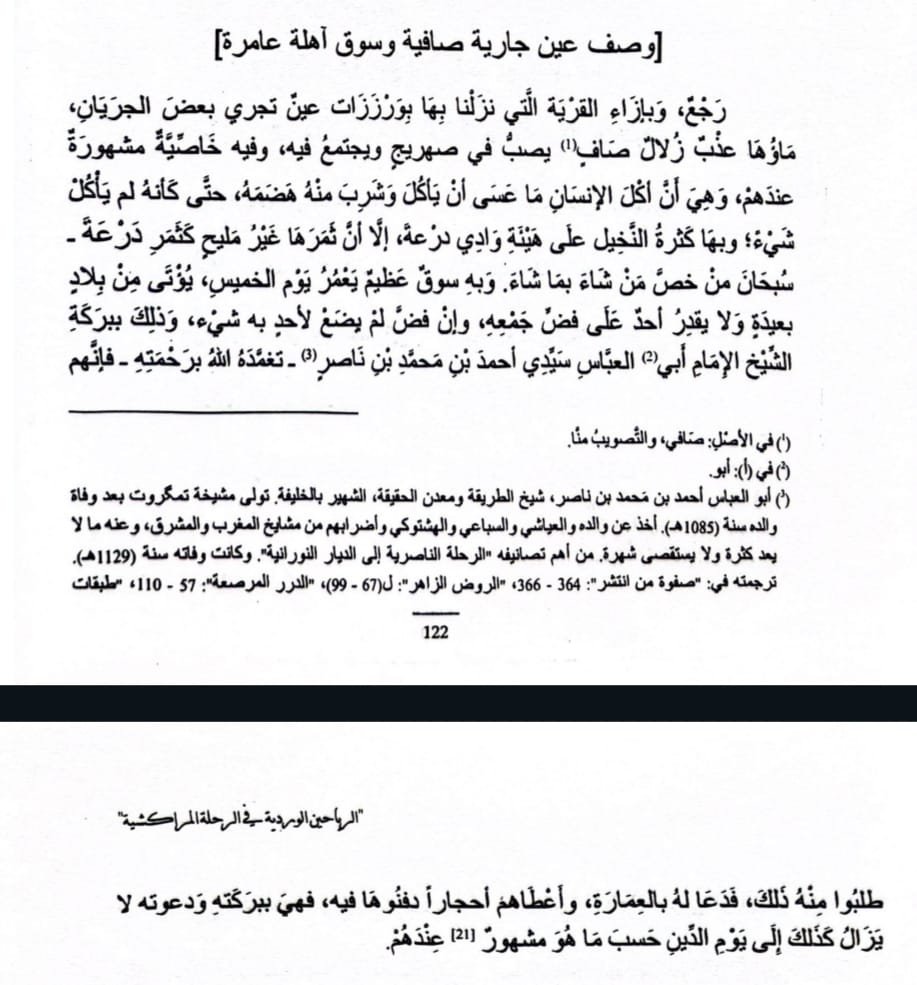
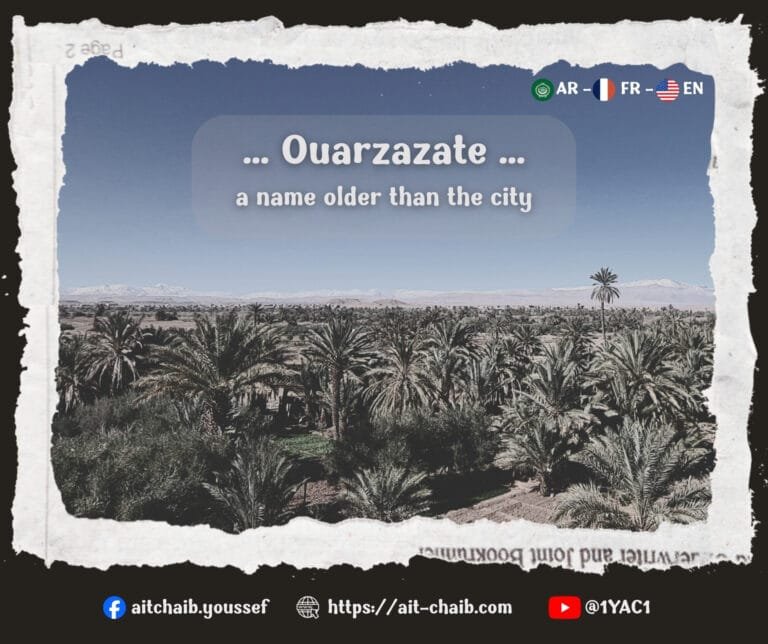
Mohammed ben Nasser ad-Dir‘i’s account in ar-Riyāhīn al-Wardiyya is one of the clearest testimonies to the existence of the Thursday market at the zaouia of Sidi Othmane and to the extent of the area known as “Warzazat” in the seventeenth century. The sheikh camped near the village and recorded a precise description of the local natural features:
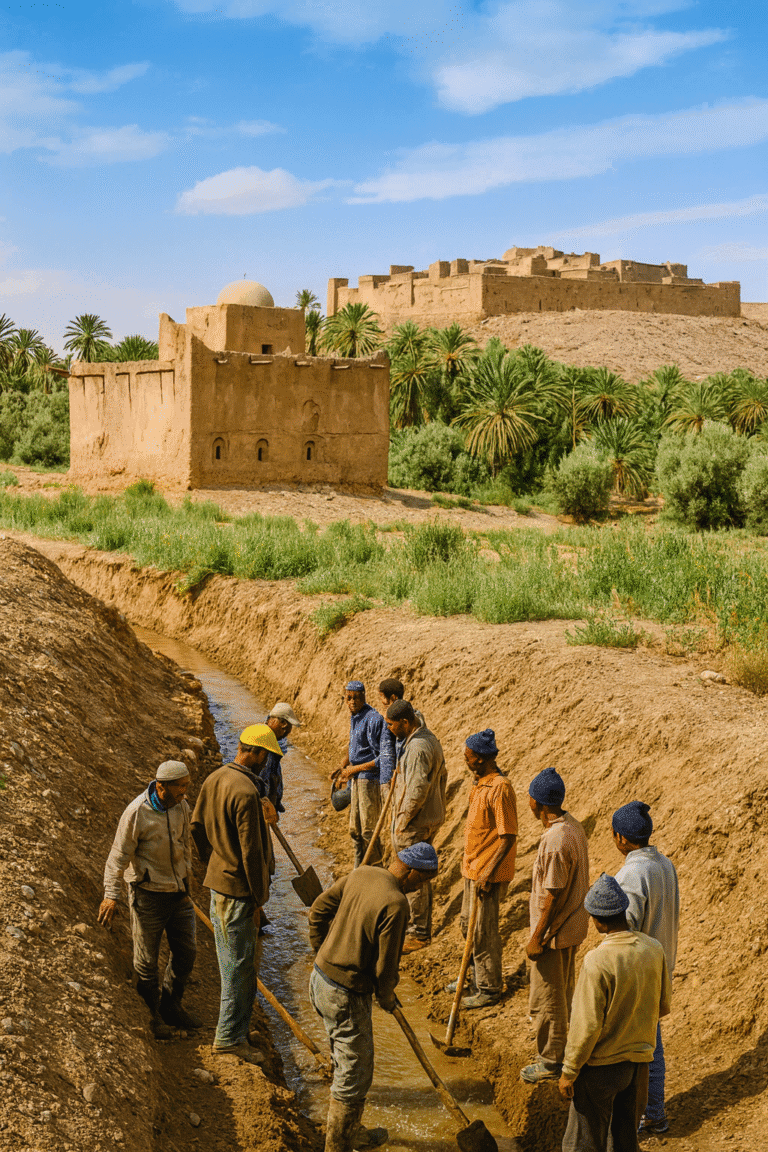
“… opposite the village where we camped in Warzazat is a spring whose sweet and clear water flows gently… it pours into a basin where it gathers…”
This description reveals a local hydraulic system composed of a spring and basin—fundamental elements of rural and agricultural settlement. He adds:
“… and it contains many palm trees, resembling those of the Drâa Valley…”
This indicates that Warzazat was already an oasis environment, tied traditionally to the broader Drâa region.
His description of the market is the most striking:
“… there is a great market held on Thursday, to which people come from distant lands, and no one can disperse its crowd…”
This sentence is decisive: it proves that the Thursday market existed long before the mid-17th century, was organized, and attracted inhabitants, nomads, and people from Drâa, Dadès, Taznakht, and beyond.
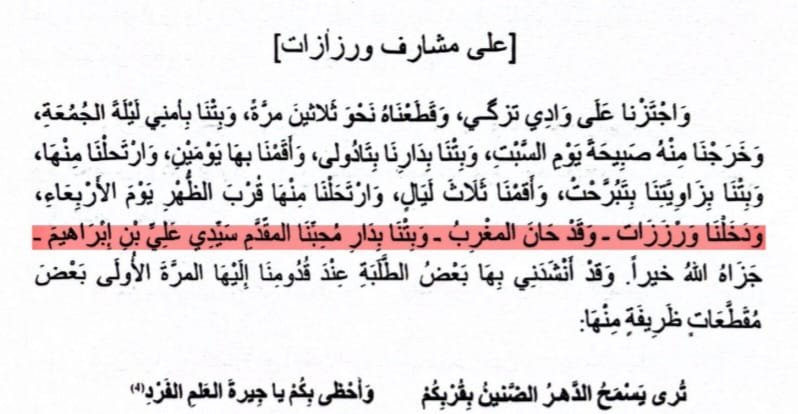
Ad-Dir‘i further notes:
“… we entered Warzazat… and spent the night at the house of our friend, the moqaddem Sidi ‘Ali ben Ibrahim… and a student recited verses to me there…”
This shows that Warzazat was not merely a transit point but a space with zaouias, students, hospitality, and cultural interaction. The zaouia of Sidi Othmane appears as a major spiritual and social anchor.
Thus, in the seventeenth century, Warzazat was already structured around three pillars:
The river – the zaouia – the market
Three components that continued to define the identity of the region long before the modern city emerged.
- Khmiss Sidi Othmane According to Charles de Foucauld (Late 19th Century)
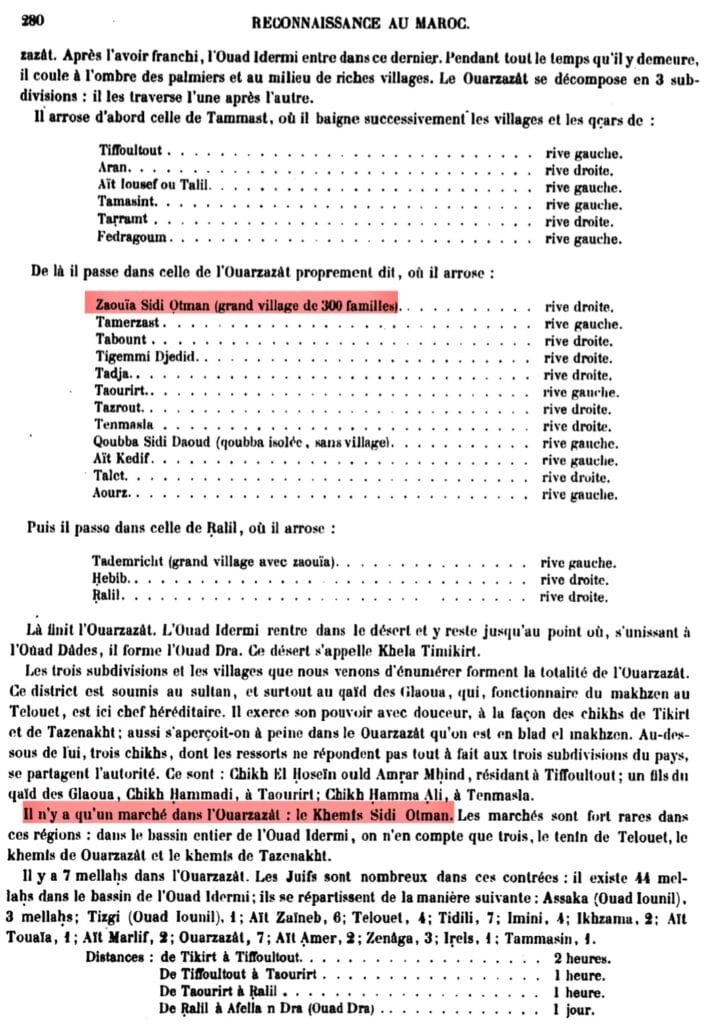
In Reconnaissance au Maroc, Charles de Foucauld provides one of the most detailed late-19th-century descriptions of the market of Sidi Othmane. His journey through the Ouarzazate basin did not lead him to a “city”—which did not yet exist—but to a broad expanse of oases and villages scattered along the riverbanks and organized around the zaouia and the weekly market.
Foucauld describes Warzazat as consisting of three groups of villages, separated and connected by the river. He lists each village, noting its location, illustrating the deeply rural character of the area. At the center of this expanse, the zaouia of Sidi Othmane stood out as the largest settlement:
“A large village of about 300 families.”
This figure is significant: it highlights the demographic and social importance of the location and demonstrates that the zaouia was not only a religious center but also a major social and economic hub.
Foucauld clearly identifies the Thursday market of Sidi Othmane as the largest in the region. It drew residents from both riverbanks, as well as people from Drâa, Dadès, Taznakht, and Aït Ouaouzguit. The market fulfilled multiple functions: weekly trade, redistribution of goods, and articulation of caravan networks.
He also notes the presence of several Jewish mellahs in various villages, confirming the social and cultural diversity of the market.
His account confirms that the Thursday market was the economic heart of the region before the city’s founding, serving as a “central market” for all surrounding communities.
- The Market in Local Documents
A. A Register from 1926
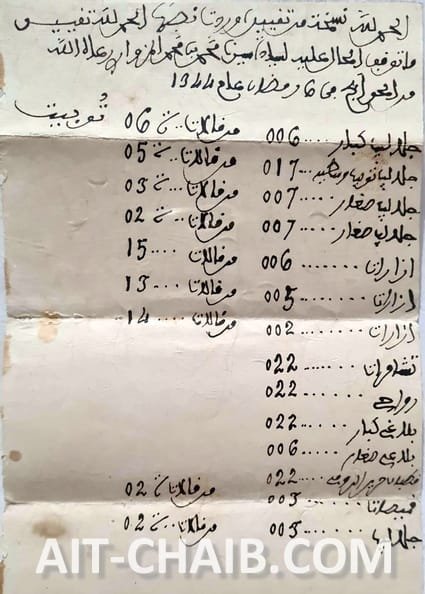
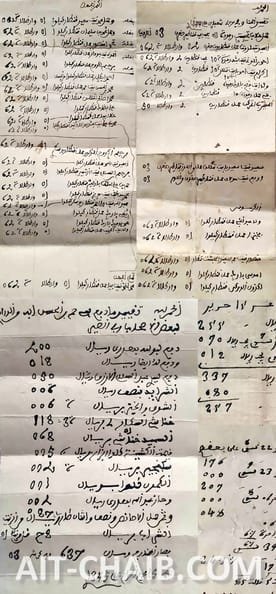
Among the local sources, a register dated 6 Ramadan 1344 / 11 March 1926, preserved at the zaouia of Sidi Othmane, records the purchases of Sidi Mohammed ben Mohammed al-Mazwar al-Glawi during the market day.
This modest document is of great ethnographic value. It lists various types of clothing—different sizes of djellabas, izars, balgha, silk threads, shirts—with precise quantities and prices. It reflects consumption patterns, the items available in the market, and the material culture of the region.
B. A Second Document from the Same Year: Goods Delivered from Marrakech
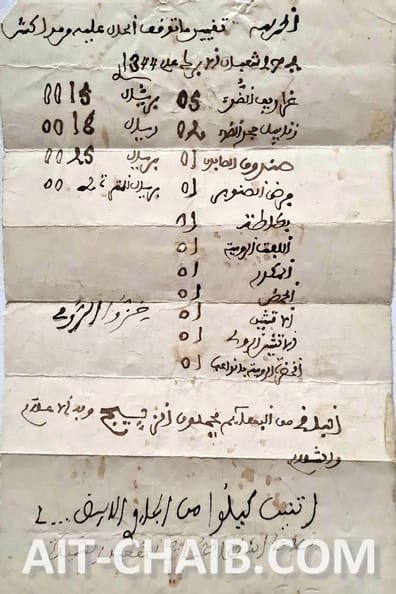
Another document dated 27 Sha‘bān 1344 / March 1926 lists goods transported from Marrakech to Ouarzazate by caravans: grains, baskets, soap, pine nuts, potatoes, imported vegetables, mandarins… as well as construction materials such as zellige tiles.
A note states:
“The remaining animals carry the zellige.”
This reveals the transport of building materials for early construction activity in Ouarzazate before the creation of the French administrative center in 1929.
Together, these documents confirm the role of the Thursday market as a major distribution hub between Marrakech and the surrounding douars.
- Economic and Social Functions of the Market
A. Economic Functions
– Supplying nearby villages with essential goods.
– Facilitating interregional exchange between Drâa, Dadès, Taznakht, Aït Ouaouzguit, and nomadic groups.
– Supporting caravan routes linking Marrakech to the South.
B. Social Functions
– Customary arbitration and conflict resolution.
– Security ensured by the prestige of the zaouia.
– Social interaction, alliances, and exchange of news.
C. Cultural Functions
– Presence of students and scholarly activity.
– Educational role of the zaouia.
The market thus embodied the cohesion of a rural space lacking urban infrastructure.
- Conclusion
The historical trajectory of the Thursday market of Sidi Othmane reveals that it was far more than a place of trade: it was the gateway through which Ouarzazate entered history. Since the seventeenth century, it brought together inhabitants, nomads, and caravans, structuring the socio-economic life of the basin.
At the turn of the twentieth century, the establishment of the French administrative center initiated a shift toward urbanization, gradually reducing the traditional market’s centrality. Yet its historical value remains: it was the earliest economic, social, and cultural nucleus around which the community of Ouarzazate crystallized.
To recover the history of Khmiss Sidi Othmane is to return to the foundational layer of the region—how people lived, traded, traveled, and interacted before the city existed.