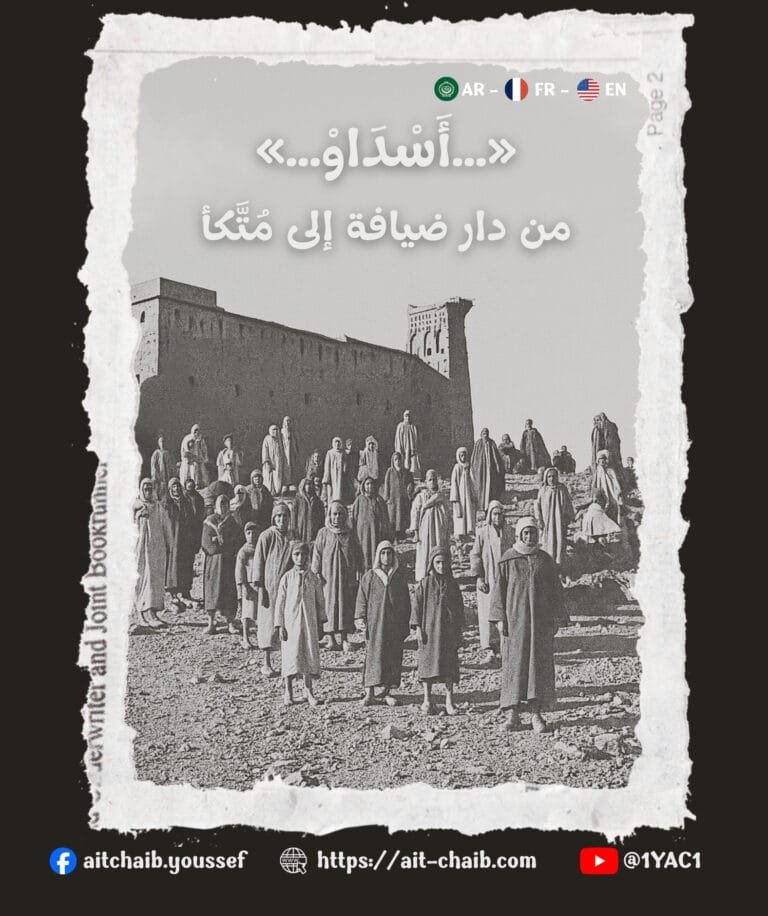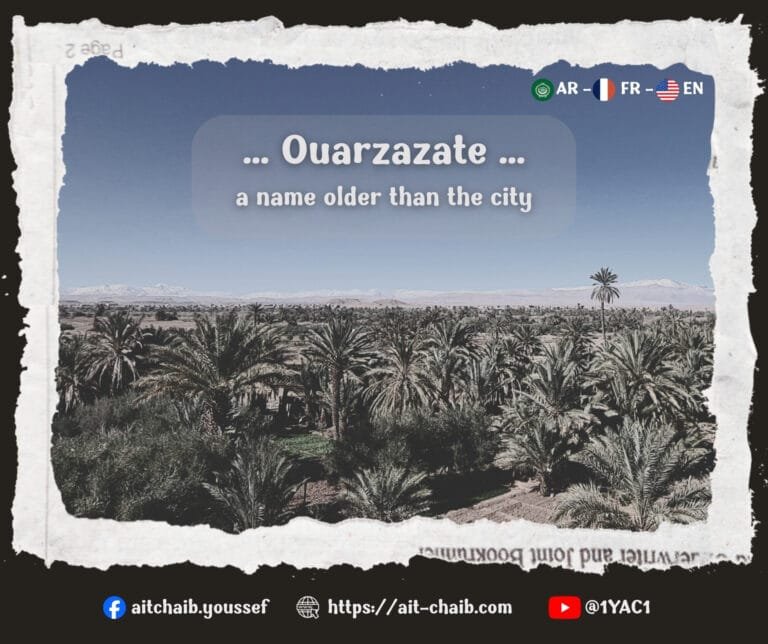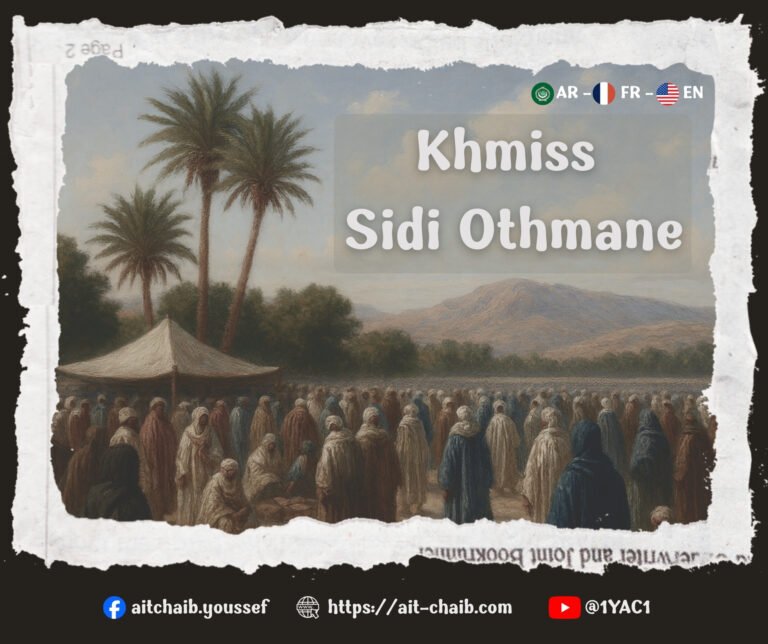

The Oldest Known Document in Ouarzazate
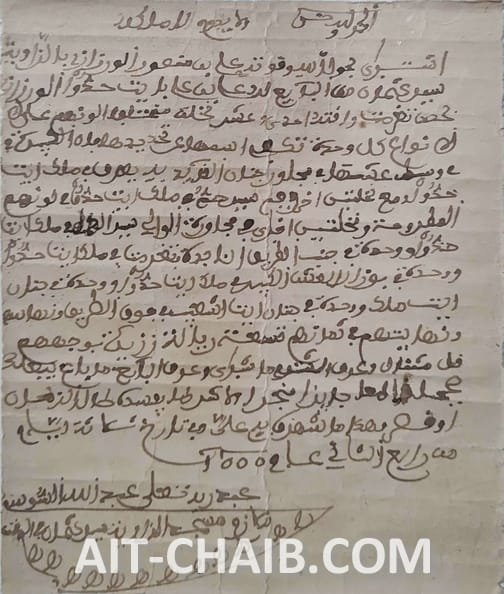
The document text in English
“Praise be to God alone, and His dominion is the only one that endures.
By the permission and power of God, ‘Ali ibn Mansur al-Warazazi‘ at Zaouiat Sidi Othmane purchased from the seller ‘Ali ibn Ali Bouhou Aït Haddou al-Warazazi‘, at ‘Hess Tighremt‘, at that time, eleven palm trees of various types and colors, each identified by its own name without need for further description.
The large palm stands at the center of its location, in the enclosure of the garden known as Jnan al-Qaid, recognized as belonging to the Aït Haddou, along with two other palms at Fumm Sidi Hammou, in the property of the Aït Haddou, of the same category.
And two other palms are located next to the shrine of the saint Sidi (…), in the property of the Aït Haddou.
And one palm beside the road crossing Tighremt, in the property of the Aït Haddou.
And one palm at Bouzar, in the large enclosure, in the property of the Aït Haddou.
And one palm in Jnan Aït Mellek.
And one palm in Jnan Aït Chaïb, above the road.
The total price for all of this is nine zazi riyals, weighing slightly less than a mithqal.
The buyer acknowledges what he has purchased, and the seller acknowledges what he has sold, a valid, lawful, and effective sale, without any condition that may nullify it, whether time grows long or short.
This is our testimony for them, dated the third day of Rabi‘ al-Thani of the year 1000.
Written by the servant of his Lord, ‘Abdallah al-Soussi,
attendant of the mosque of Zaouiat Sidi Othmane at that time.”
- Introduction
During my research into the history of Zaouiat Sidi Othmane — this small village that carried the memory of my ancestors and my childhood — I came across an old document and made sure to preserve a clear image of it. As soon as I began reading it, I realized that I was looking at a historical text of great significance, not only for a family or a village, but for the entire history of Ouarzazate.
The document is dated 1000 AH / 1592 CE, at the height of the Saadian era under Sultan Ahmed Al-Mansour Al-Dhahabi. This makes it one of the oldest local documents known in the region.
It is neither a religious manuscript nor a royal decree, but a seemingly simple document: a contract for the purchase of palm trees.
Yet its value goes far beyond its immediate content; it opens a window onto daily life, land ownership, family lineages, local economic networks, the structure of gardens and fields, and the meaning of a “zaouia” when it was a vibrant center of community life.
- Context and Dating of the Document
The document begins with the traditional formula used by notaries:
“Praise be to God alone, and only His dominion endures.”
It then details the transaction with precision: the buyer, the seller, the location of the palm trees, the price, and the date of the contract.
The date is the third day of Rabi‘ al-Thani, 1000 AH,
which corresponds to 18 January 1592 CE.
This dating situates Zaouiat Sidi Othmane firmly within the Saadian period, a time when roads, caravans, and trans-Saharan trade were flourishing. The document confirms that the mausoleum of the saint Sidi Othmane existed more than 450 years ago, and that the village was not a minor settlement but an organized center with gardens, defined boundaries, and a clear system of property ownership.
- The Parties to the Contract: Families and Lineages
The document clearly lists:
Buyer:
Ali ibn Mansour al-Warazazi
Seller:
Ali ibn Ali Bouhou Aït Haddou
Scribe and Witness:
Abdallah al-Soussi, attendant of the mosque of Zaouiat Sidi Othmane
These names are not incidental; they are historical evidence that ancient families from Ouarzazate were already established in the zaouia as early as the 16th century:
the Mansour family, the Haddou lineage, the Aït Chaïb family…
This confirms that the village is not recent or newly formed, but deeply rooted in history, and that its present-day inhabitants are the direct descendants of generations stretching back four or five centuries.
4. The Locations of the Palm Trees : A Map of the Village in the 16th Century
One of the most striking features of the document is its meticulous description of where the palm trees were located — as if reading a hand-drawn map written by a notary 450 years ago:
- Jnan al-Qaid (The Qaid’s Garden)
- Foum Sidi Hammou
- Near the shrine of the wali Sidi (…)
- Bouzar
- Jnan Aït Mllek
- Jnan Aït Chaïb
Some of these names are still known today, others have changed or disappeared.
But the document provides material evidence of a structured land-ownership system, the presence of old shrines (Sidi Hammou – Sidi Othmane – Sidi (…) ), and families or clans who shared the gardens of the village.
It is not merely a purchase contract; it is a historical map.
- The Price: Nine Riyals — What Was Their Value?
The document states that the price was:
“Nine zazi riyals, weighing less than a mithqal.”
Economically speaking:
The “zazi riyal” refers to the Jaziri riyal, named after Algeciras in Spain, where several coins were minted.
The Spanish riyal at the time was worth about 3 grams of gold.
Thus:
9 riyals ≈ 27–30 grams of gold
This was a substantial amount at the time, enough to purchase:
a medium-sized bull
or 4–5 sheep
or a quantity of wheat sufficient for several months
or the salary of a jurist (faqih) for several months
For a farmer in Zaouiat Sidi Othmane, purchasing 11 palm trees was a significant long-term investment.
- What the Document Reveals About the Zaouia’s History
1) The antiquity of settlement
The 1592 date proves that the village has been inhabited for at least five centuries.
2) The zaouia as a center of life
The presence of a mosque, a notary, gardens, routes, and shrines indicates that the village was both a religious and economic center in the region.
3) A local legal system
The contract follows the Maliki legal tradition, showing that notaries and scribes operated locally.
4) The importance of gardens and palm trees
Palm trees were a form of capital, revealing the agricultural and oasis-based economy of pre-modern Ouarzazate.
5) Family names preserved
The document records the names of families and lineages such as:
Aït Haddou – Aït Chaïb – Aït Mllek – al-Warazazi – al-Soussi.
7. Why is this type of document important?
The history of Ouarzazate still needs to be written from the perspective of its own people, as most of the existing accounts were originally produced outside the region, whether in the reports of military officers and administrators or in the writings of foreign travelers and researchers. This does not diminish the value of those sources; they remain essential for understanding the past. However, their meaning becomes complete only when they are examined alongside local testimonies, traditional legal records, and the materials that preserve the region’s internal memory.
Such documents provide an unembellished and transparent history, serving as living witnesses to the daily lives of our ancestors and preserving information that cannot be found in conventional historical books. They also play a crucial role in tracing family lineages and the relationships that connect them.
This body of local documentation constitutes a scientific resource that helps redraw the historical landscape of Ouarzazate prior to the modern era.
It is a history written with ink that never dries.
- Conclusion
This document is not merely an old sheet of paper.
It is a voice from the year 1000 AH, telling us that Zaouiat Sidi Othmane was a lively, inhabited, and active village, where people wrote, traded, witnessed transactions, cultivated their land, and protected their gardens and palm trees.
Recovering such documents is, at its core, a recovery of the true memory of Ouarzazate — a memory that still awaits proper documentation.
I will continue, as much as I can, to collect these fragments, piece by piece, to rebuild an accurate historical portrait of our zaouia and our region.