
- Introduction
Water resources in Ouarzazate constitute one of the fundamental keys to understanding the history of settlement and traditional modes of life in the region. In a dry environment marked by severe climatic fluctuations, water was not merely a natural element; it served as the core of a precise social and economic organization that defined ownership mechanisms, irrigation rules, and land-management strategies. Local documents and accounts of travellers from past centuries show that water scarcity generated constant challenges, and that collective thinking on irrigation and the distribution of shares was an essential aspect of daily life.
These conditions led to a highly structured system for defining water ownership for agricultural irrigation, whether in the form of time-based shares or inherited rights. The same conditions also produced strict customary norms governing irrigation schedules, access rules, and individual responsibilities. These norms were not simply practical solutions; they formed a complete social framework involving the community, local elders, and tribal representatives, all operating within a structure shaped by customary, ethical, and religious principles.
Studying water ownership and irrigation systems in Ouarzazate is therefore not merely an attempt to revive a technical heritage. It is a way of understanding how the local community built its relationship with nature and how it managed to transform a limited resource into a long-lasting system of cooperation, regulation, and production. Through the analysis of these traditional patterns, one can illuminate important aspects of the region’s social and economic history and highlight the crucial role water played in shaping its territorial and cultural identity.
- Geographic and Historical Context of Ouarzazate
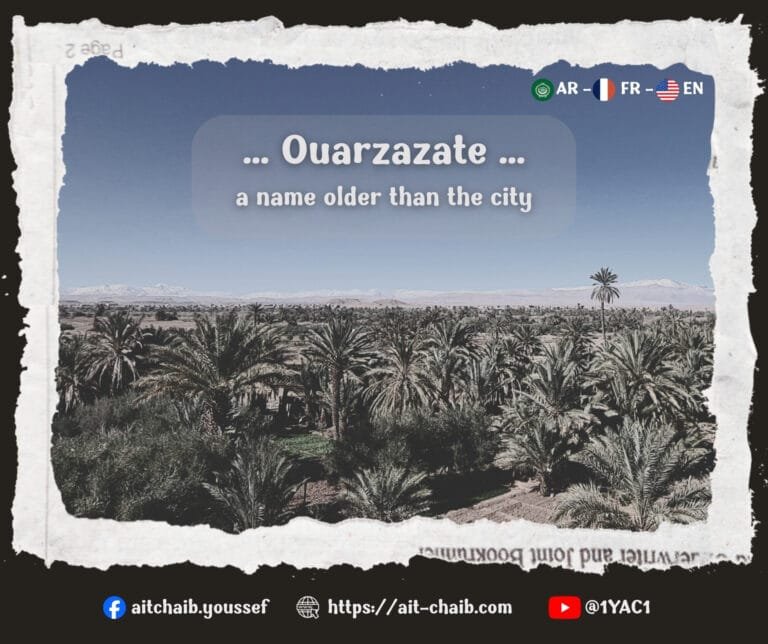
Ouarzazate lies within a region characterized by scarce and seasonally variable water resources, where the semi-arid climate determines all agricultural and urban activities. Villages and ksour were often established near seasonal rivers and waterways, allowing the inhabitants to benefit from periodic floods and the few local springs that served as primary water sources. Many areas in Ouarzazate still show traces of ancient irrigation networks originating from small or seasonal sources, distributed across farmlands according to precise rules that ensured the efficient use of every drop of water.
The region depends on a limited diversity of water sources: small local springs, the seasonal flows of the Ouarzazate river, and carefully dug irrigation canals (seguia) that transport water across varying distances. Historically, this situation led residents to devise relatively complex systems to control water flow and distribution. These systems share certain principles with those found in the oases of the southeastern Moroccan valleys, yet they retain local specificities linked to the terrain and to the settlement patterns of ksour and douars.
The history of irrigation in Ouarzazate reveals a long and cumulative process: the forms of the irrigation canals changed depending on the era and climatic conditions. Over time, a network of water channels developed, adapting to natural slopes and agricultural needs, rebuilt and maintained according to flood seasons and spring levels. This evolution demonstrates that irrigation was not a fixed technique but part of a dynamic social history shaped by available resources. This can still be observed today in the persistence of certain canal names and their traditional functions.
- The Social Structure of Water Ownership and Its Link to Irrigation Canals
A – Mechanisms of Water Distribution
Water ownership in Ouarzazate is inseparable from the irrigation canals that carry water to the fields of each douar. The canal is not merely a conduit; it is an organizational framework linking the farmlands and embodying the relationships that define access rights. Observation of local networks shows that water ownership is often distributed along specific segments of the canal or according to time-based shares within the irrigation turn, making the canal a practical medium through which inherited or acquired rights are expressed.
B – Material Structure of the Canals
Among the main irrigation canals of the farmlands of the Zaouia Sidi Othmane, the following stand out:
“Targa n Sidi Athman”, named because it passes near the shrine of Sidi Othmane.
“Targa n Tamzaourout”, likely derived from Tamzwarout (“the first”), as it is considered one of the oldest canals in the area.
“Targa n Bouslan”, built by the French around 1936, “Pouzzolane” is a volcanic material mixed with cement to enhance water resistance. Locally, it is also called “Targa n Ormmoui” (“the canal of the Christian”).
The names of canals in Ouarzazate, as in many oases of the southeastern Moroccan valleys, carry historical and social significance. They are often linked to shrines, well-known sites, or tribal groups, embedding them in the collective memory. A canal may also irrigate farmlands belonging to several douars, such as Targa n Tarmikt, with precisely defined shares for each cultivated area. This results in layered forms of ownership: individual, familial, and communal.
In some cases, a canal is divided into segments whose value varies depending on proximity to the water intake and the strength of the flow. These variations create unequal access rights, and the irrigation network becomes a living map of property relations and social balances within the douar.
C – “Aggoug”
Most canals in Ouarzazate begin with a traditional structure called “Aggoug”, a small earthen dam built across the watercourse to raise the water level and allow it to enter the main canal (Imi n Targa). This structure is built collectively and must often be rebuilt after floods, reflecting the cooperative nature of local agriculture. From this point, the main canal divides into secondary branches according to natural slopes.
D – Sanctions and Fines (“Azzaïn”)
Respect for the irrigation turn is a fundamental principle of the system. Any violation—such as opening the water early or diverting it secretly—is considered an infringement on collective rights. Sanctions, known as “Azzaïn”, may consist of fines or additional maintenance work on the canal (Hadd essaym). In certain cases, the offender may temporarily lose access to their water share.
- Sources and Documents
Documentation regarding the history of water in Ouarzazate is essential to understanding the evolution of water rights, whether in the traditional customary phase or in the later period marked by technical and administrative interventions. Although ancient documents concerning the sale or inheritance of water shares are rare, available legal texts and administrative archives provide a coherent image of how the system developed.
A – An Old Legal Document (1262 AH / 1846)
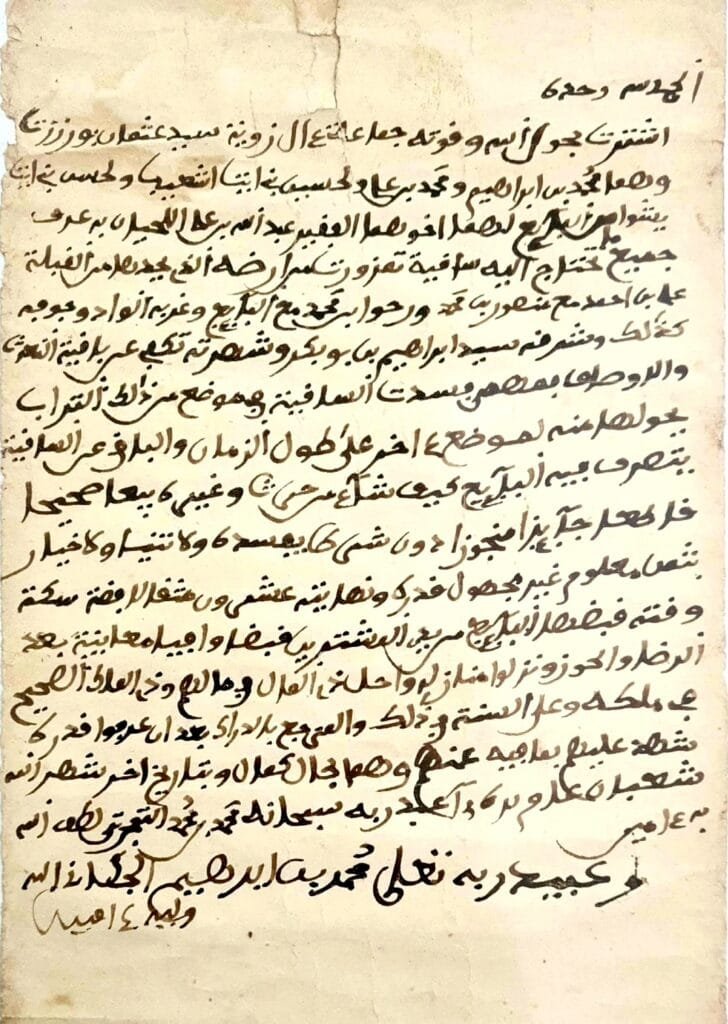
One of the most significant testimonies is a document dated to the end of Shaaban 1262 AH (1846), granting permanent authorization for the canal “Tamzaourt” to pass through a plot owned by Abdallah ben Ali Al-Hiyane, for the benefit of a group from the Zaouia Sidi Othmane: Mohammed ben Ibrahim, Mohammed ben Ali, Lhoucin N’ait Chaïb, and Lhassan of Aït Ichou.
The contract grants the community a perpetual right of passage through private property in exchange for twenty mithqals of silver, demonstrating the possibility of buying and selling hydraulic rights. It also allows for the canal to be rebuilt or relocated within the same plot should it be damaged by floods. The plot’s boundaries are described in detail, while ensuring the owner’s full rights over the remainder of his land.
This document is strong evidence that the canal was not merely an engineering structure but carried legal, social, and economic value, capable of establishing enduring rights that exceeded mere landownership.
B – Modern Administrative Documents
Other twentieth-century documents reflect the evolution from a traditional system to one characterized by technical management:
- Irrigation Schedules and Irrigated Areas
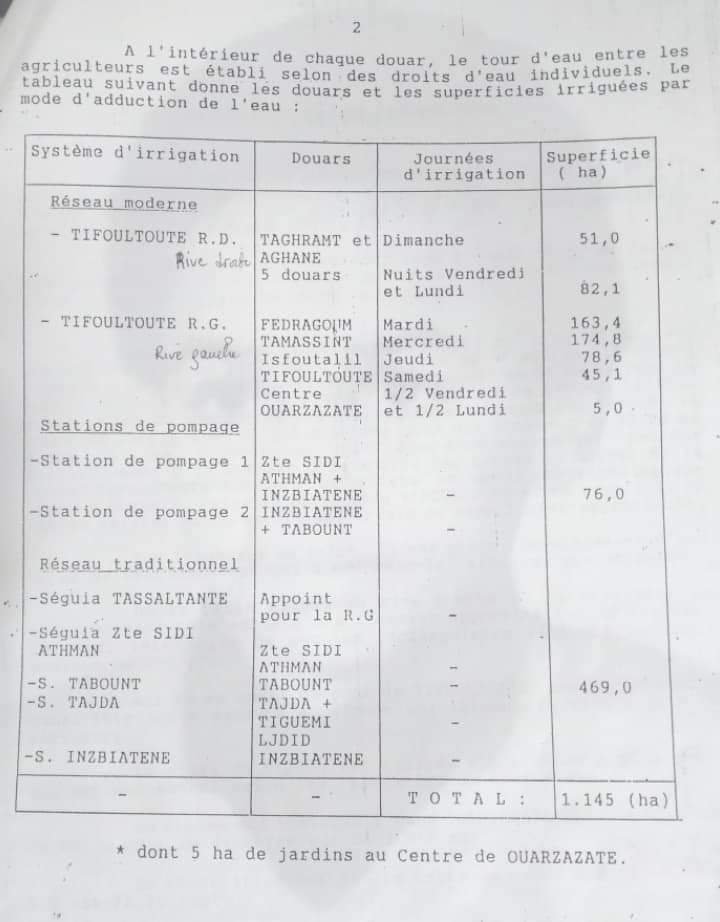
An administrative archive records the distribution of irrigation days among the douars, maintaining the traditional principle of the irrigation turn but formalized through an official schedule.
- The Tifoultoute Diversion Dam (1936)
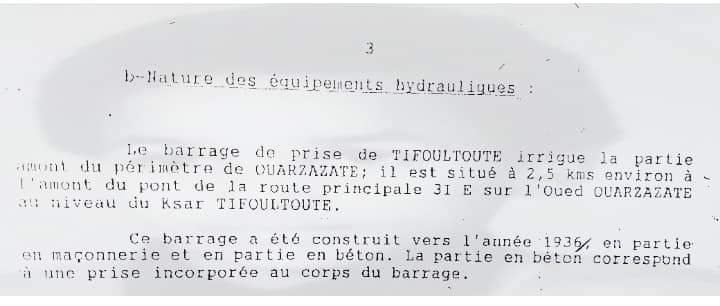
Another document describes the construction of the Tifoultoute diversion dam in 1936, built of stone and cement. This structure did not replace traditional devices such as the “Aggoug” but complemented them, creating a hybrid system in which modern engineering coexisted with older techniques.
C – Significance of These Documents
Traditional phase: water rights based on custom and validated by legal contracts.
Modernization phase: introduction of hydraulic engineering and administrative regulation.
Continuity: despite changes, the principles of shared use, canal passage, and collective regulation remained intact.
- Conclusion
Tracing the historical development of water management in Ouarzazate reveals that this scarce resource formed the basis of a complete social system built on cooperation, internal balance, and established customary rules. Water scarcity shaped strict forms of hydraulic property—time-based shares, rights of passage, and canal paths transformed into legal, economic, and social structures.
The canals—whether in the farmlands of Zaouia Sidi Othmane or elsewhere—stand as the core of this system: irrigation conduits on one hand, social institutions on the other. The 1262 AH contract authorizing the passage of the “Tamzaourt” canal demonstrates the depth and precision of this organization, showing the community’s ability to establish durable, balanced, and enforceable water rights.
The administrative documents of the twentieth century show that technical innovations did not eliminate traditional rules but complemented them. The irrigation turn, rights of use, and collective management logic remained central, reflecting the continuity of a system that adapted to change without losing its essence.
Thus, the history of water in Ouarzazate is not simply the history of an irrigation technique; it is the history of a society, its adaptive strategies, its cooperative traditions, and its relationship with scarcity. The available documents, scarce but invaluable, are essential tools for reconstructing this memory and highlighting the need to preserve such traces to understand the deep dynamics of a territory shaped by water.