
- Introduction
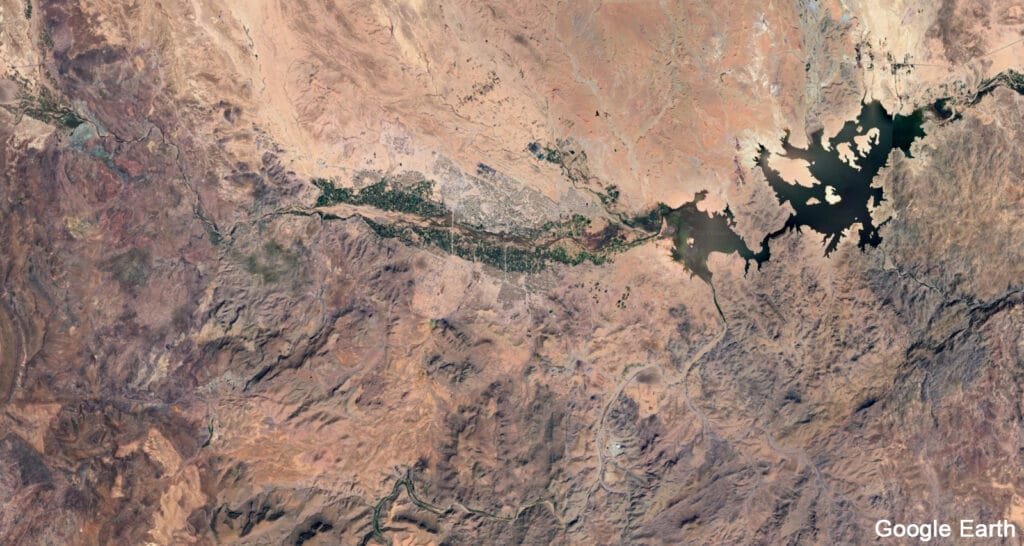
Originally, the name Ouarzazate did not designate a city, but a precise topographical feature of a riverbed. In the local Amazigh language, it is formed from “war” and “zazat”, meaning “without noise.” The expression refers to the point where the river widens after leaving the narrow passage coming from Aït Zineb, softening the sound of its flow before narrowing again toward the Drâa. Several old notarial documents confirm this early geographical meaning by explicitly referring to “Oued Ouarzazate” long before the modern town existed. The later popular interpretation of “war zazat” as “the quiet city” is simply an extension of this original meaning tied to the river.
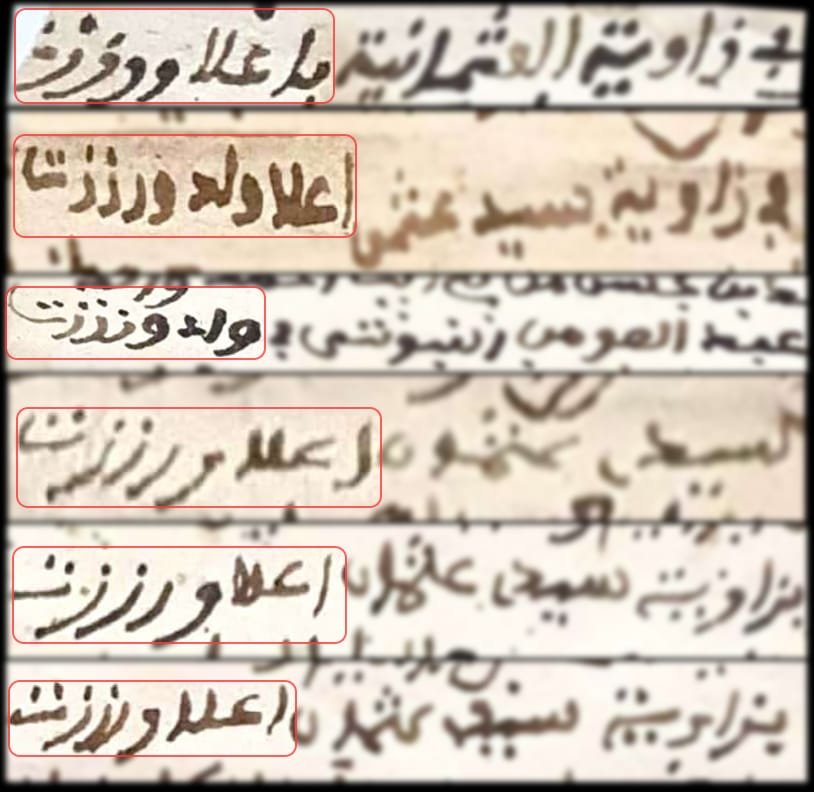
For centuries, Ouarzazate referred to a landscape of villages along the river, as reflected in local deeds and historical sources. It was not an urban centre but an open space crossed by travellers, marked by shrines and zawiyas such as “Sidi Othman”, “Sidi Abderrahman Olhaj”, “Sidi Daoud”, and “Lalla Acha Oult El Hassan”.
The name appears in widely separated historical sources:
in the 11th century in al-Bakrî’s Book of “Routes and Realms”, in the 17th century in Mohammed ben Nacer al-Dra‘i’s al-Riyāhîn al-wardiyya, in the late 19th century in Charles de Foucauld’s Reconnaissance au Maroc, and finally in the early 20th century French administrative documents studied by Ibrahim Yassine.
This article examines these sources to understand how the name Ouarzazate evolved from a river to a broad social space, and eventually into a city.
- Ouarzazate in al-Bakrî’s “Routes and Realms” (11th century)
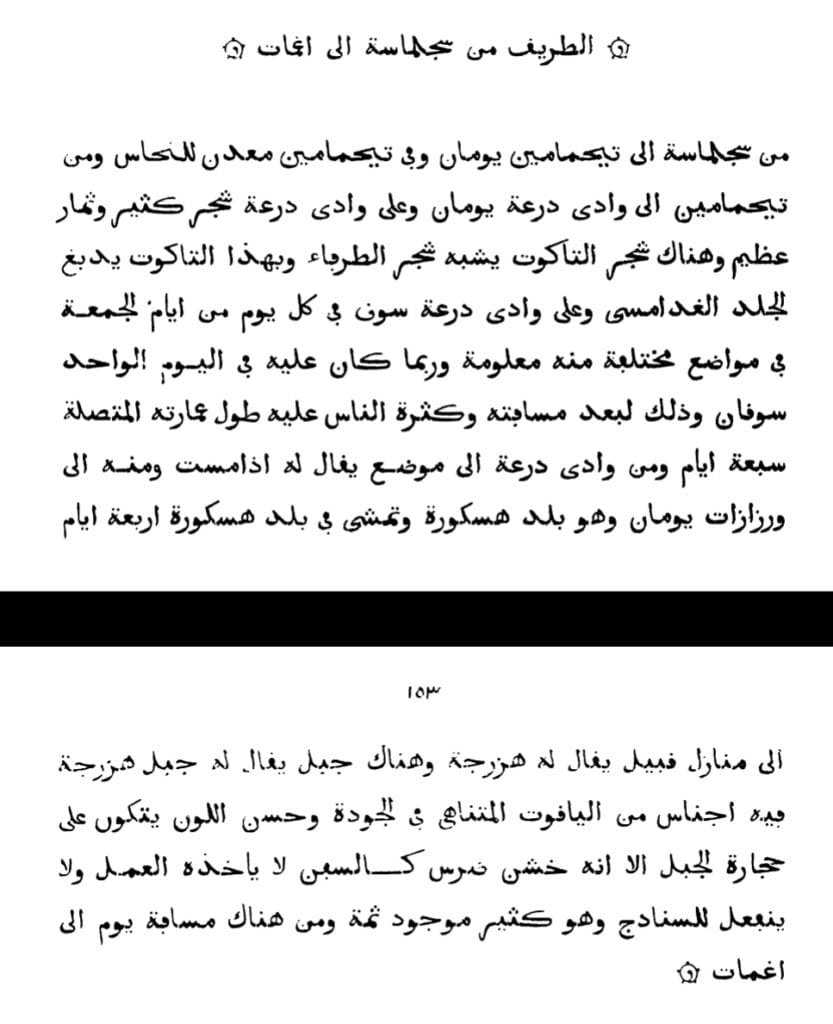
Al-Bakrî’s reference to Ouarzazate is one of the earliest written mentions of the name. It appears in his description of the caravan route connecting Sijilmassa and Aghmat, where he lists the successive regions and rivers encountered along the way. He writes: “…Ouarzazat, belonging to the Haskoura…”, indicating that in his time it was part of tribal territory, not a built settlement.
He does not describe inhabitants or urban features, confirming that Ouarzazate was understood as a geographical space related to the river valley. Despite its brevity, this reference provides the earliest medieval attestation of the name.
- Ouarzazate in Mohammed ben Nacer al-Dra‘i’s al-Riyāhîn al-wardiyya (17th century)
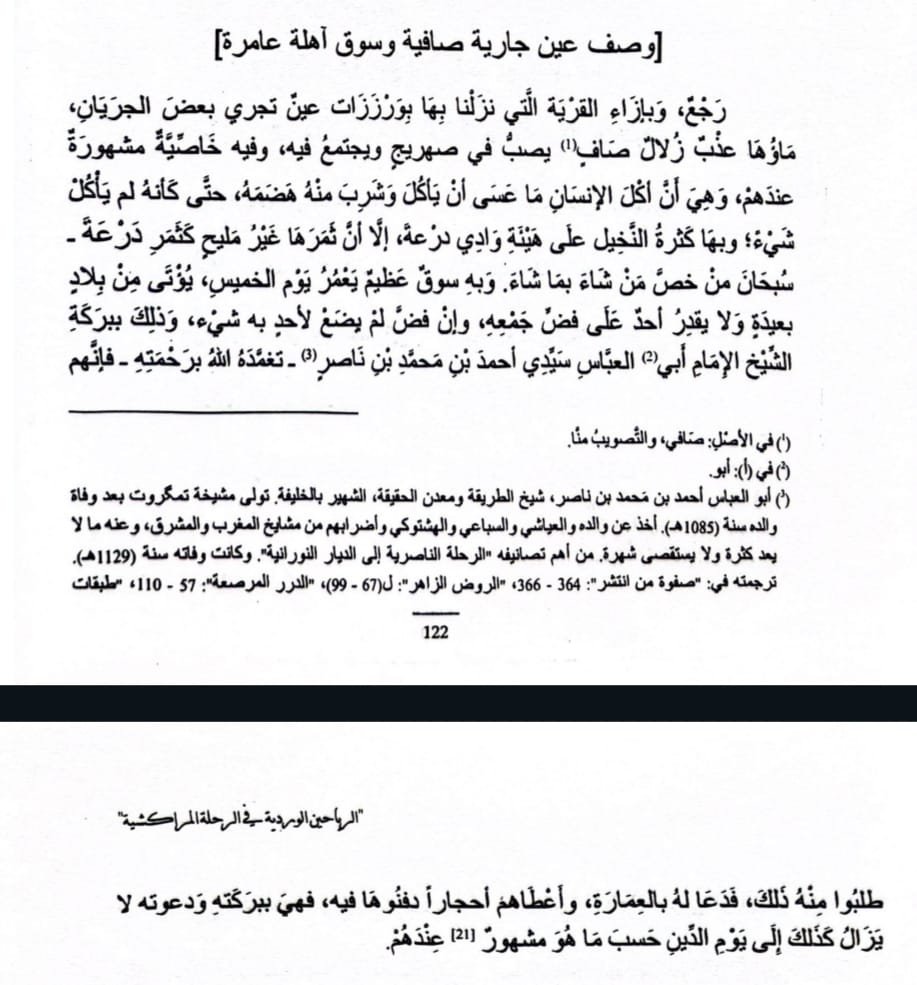
During his journey between Tamgrout and Marrakech, al-Dra‘i mentions Ouarzazate on both outward and return trips. His account is valuable because he knew the southern routes well and described what he saw accurately.
He reports stopping in a village called Bourzazat, describing a running spring, an active Thursday market, palm groves, crops, and the everyday life of the inhabitants. All of this shows that in the 17th century, Ouarzazate was a rural space made of dispersed villages tied to the river and natural passes.
He never refers to a city named Ouarzazate, but to a large region he crossed and where he spent the night. The market he describes is almost certainly the Thursday market of the Zawiya Sidi Othman, the major local souk for centuries.
Al-Dra‘i’s testimony confirms that before the 20th century, Ouarzazate was a rural expanse centred on its river.
- Ouarzazate in Charles de Foucauld’s “Reconnaissance au Maroc” (late 19th century)
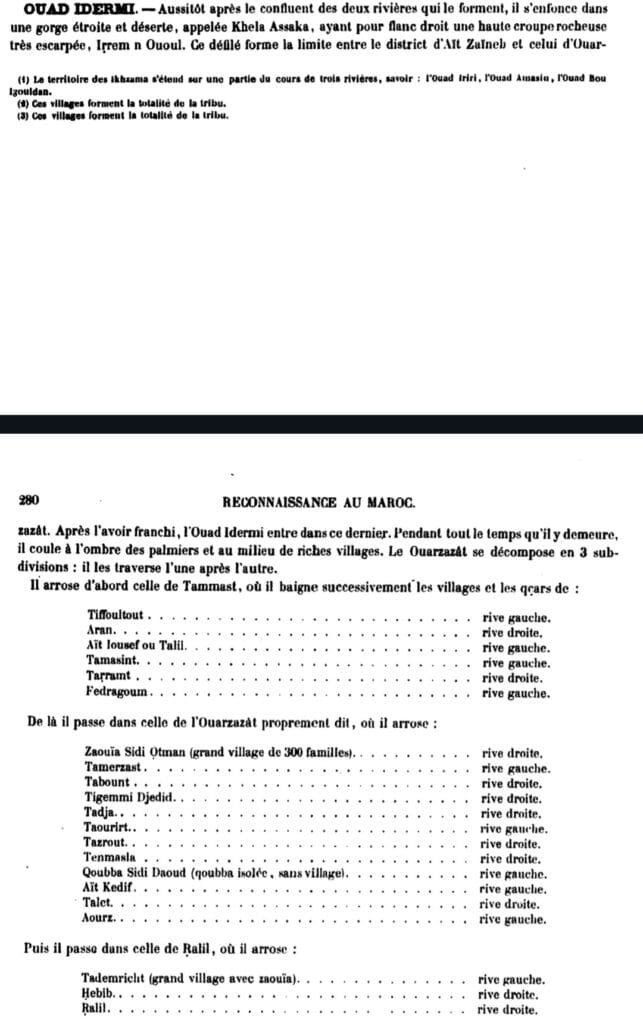
Although Charles de Foucauld did not enter the area of today’s city, his passage along Oued Idermi allowed him to observe numerous villages belonging to the Ouarzazate basin. His description is one of the most detailed European accounts of the region before modern changes.
He explains that Ouarzazate consisted of three groups of villages, which he lists one by one, specifying the riverbank where each is located. He identifies the Zawiya Sidi Othman as a “large village of about 300 families,” one of the earliest clear Western attestations of its importance.
Foucauld does not describe a city but a large oasis system including villages like Tifeltoute, Tamassint, Tabount, and Tikmi N’Jdid. He also notes that the main regional market was the Thursday market of Sidi Othman.
He reports the presence of several Jewish mellahs distributed among the villages of the Ouarzazate basin, showing the area’s social diversity at the end of the 19th century.
His testimony confirms that Ouarzazate was a wide oasis region with agriculture, palm groves, and caravan routes, but no urban centre.
- Ouarzazate in Ibrahim Yassine’s study (20th century)
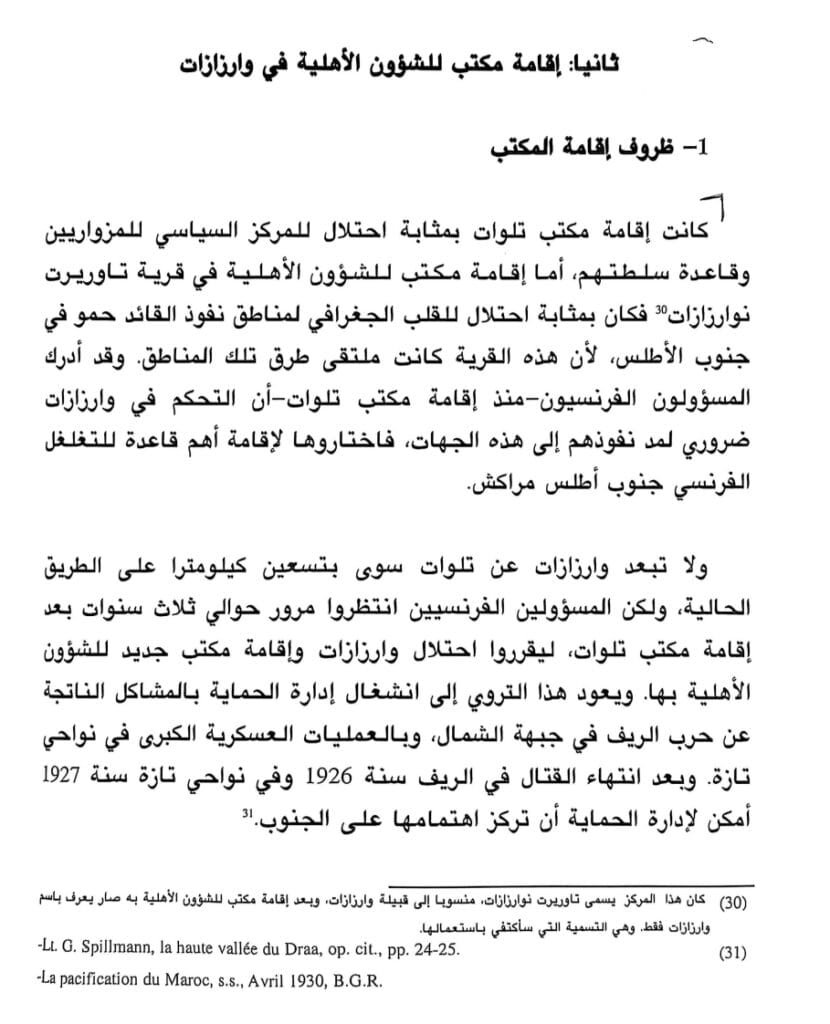
Early French colonial archives do not describe Ouarzazate as a town but as a wide tribal space dominated by Aït Ouaouzguit groups and their neighbours. Its strategic location at major crossroads made it essential in French operations south of the Atlas after 1920.
According to Yassine, choosing Ouarzazate to host a Bureau of Native Affairs was deliberate: it linked Marrakech with the Drâa, the Souss, and Tafilalet, and lay at the “heart of the territory” controlled by the powerful caïd Hammou.
After years of relying on the Telouet office, French authorities decided to establish a second administrative base in Ouarzazate. Construction began in late 1927 and early 1928. In July 1929, a decree officially transformed Ouarzazate into a “cercle headquarters”, a local administrative capital overseeing nearby tribes.
This decision marks the real birth of the modern city. The development of roads and the consolidation of administrative structures gradually shaped an urban nucleus for the first time.
- Conclusion
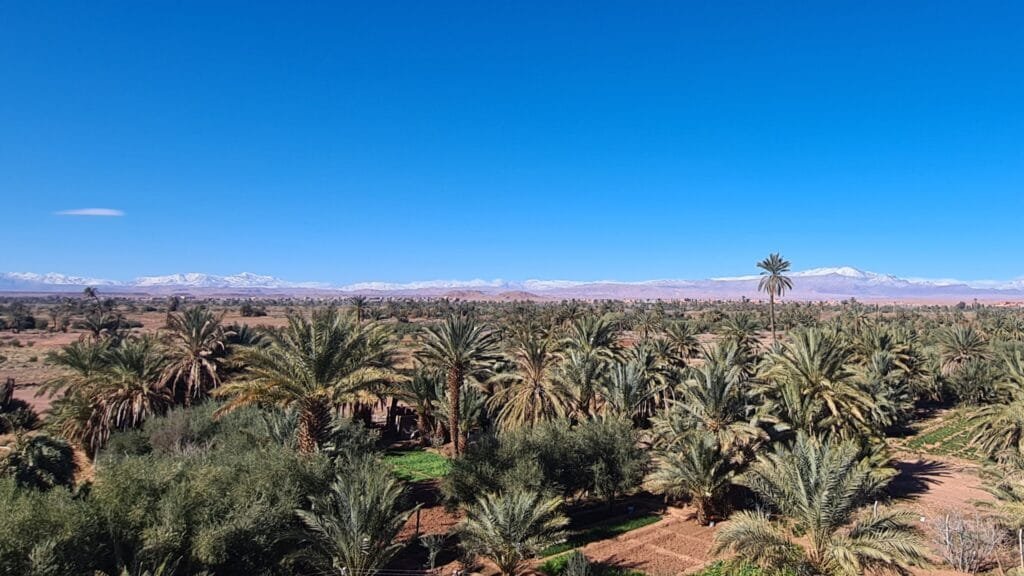
Across the sources — from the 11th to the 20th century — a clear trajectory emerges: Ouarzazate did not originate as a traditional Moroccan city built around a kasbah or ancient nucleus. The name first referred to a physical feature of the river, then to a rural region of villages, and only later became an administrative hub in the early 20th century.
The emergence of the city is therefore the product of geographical, economic, and political transformations, culminating in French colonial administration. This makes Ouarzazate a unique case in the urban history of southern Morocco: a city born not from ancient urban continuity, but from the evolution of space, power, and movement.